
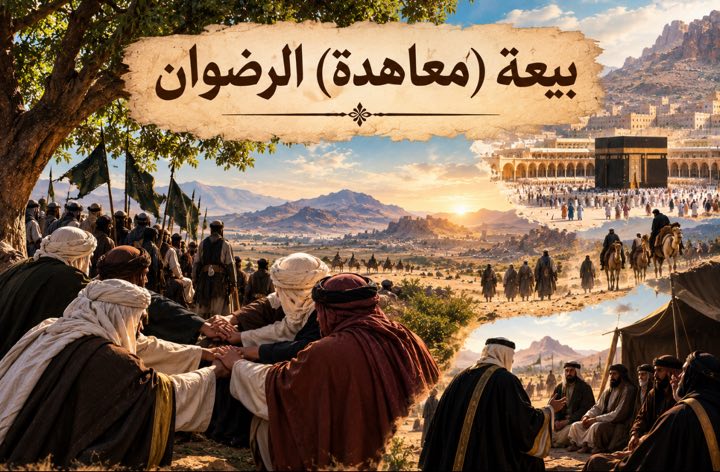
بيعة (معاهدة) الرضوان
بعد أن كسُرت شوكة قريش في المفاوضات في صلح الحديبية، وأصبحوا أمام العرب في موقف {{ المتهم }} بسبب سماحها لجميع العرب بالدخول للكعبة و أداء الحج إلا المسلمين فأخذت قريش تفكر في قبول الصلح مع المسلمين،،،،ولكن كانت هناك معارضة من شباب قريش المتحمس أو المتهور لأن هؤلاء الشباب نشؤوا على كراهية الإسلام ، وكراهية النبي حيث عندما جاء الإسلام كانت اعمارهم مابين ٦ الى ٩ سنين و تَشَرَّبوا كراهية الإسلام، و فوق ذلك، مات لكثير منهم آبائهم وأقاربهم في مواجهات مع المسلمين، مثل {عكرمة بن أبي جهل} الذي قُتل أبوه في بدر ،،،،،وغيره الكثير، ولذلك فهم لا يتصورون عقد صلح مع المسلمين وحاولوا هؤلاء الشباب منع أي طريق للصلح،،، فقامت مجموعة منهم وعددهم ٥٠ شاب من قريش في التسلل الى معكسر المسلمين ليقتلوا بعض أصحاب رسول الله ، بغرض أن يوقعوا الفتنة بين الفريقين ، وتكون شرارة الحرب بين رسول الله ة وقريش وكان النبي قد وضع حراسة قوية حول معسكر المسلمين على مدار الساعة وجعل قيادة هذا الحرس {{ محمد بن مسلمة }} فلما اقترب هؤلاء الشباب من قريش ، من معسكر المسلمين ، أحاط بهم الصحابة، وتم القبض عليهم وقيدوهم وجائوا بهم الى النبي وهم مقيدون وكانت عملية القبض على هؤلاء الشباب صعبة جدا، لأن عددهم كبير، وهم مسلحون، ولأن القبض عليهم تم دون اراقة دماء من كلا الجانبين فلما رائهم النبي واخبره الصحابة بخبرهم قال النبي :_ اطلقوا سراحهم أُطْلِق سراح ٥٠ شاب من قريش ، دون حتى أن يُطلب فيهم فداء، حتى يفسد عليهم مخططهم في افساد جهود المصالحة وبذلك جعل النبي هذه الحادثة أمر في صالحه، أكد به أنه قد جاء للعمرة وليس للقتال، وأن طلبه للهدنة جاء من مركز القوي وليس الضعيف وقد ذكر تعالى هذا الموقف في سورة الفتح فقال تعالى {{ وَهُوَ الَّذِي كَفَّ أَيْدِيَهُمْ عَنْكُمْ وَأَيْدِيَكُمْ عَنْهُمْ بِبَطْنِ مَكَّةَ مِنْ بَعْدِ أَنْ أَظْفَرَكُمْ عَلَيْهِمْ ۚ وَكَانَ اللَّهُ بِمَا تَعْمَلُونَ بَصِيرًا }} وَهُوَ الَّذِي كَفَّ أَيْدِيَهُمْ عَنْكُمْ - فلم ينجحوا في قتل أحد، وفشل مخططهم وَأَيْدِيَكُمْ عَنْهُمْ فلم تقتلوهم {{ بِبَطْنِ مَكَّةَ }} أي في الحديبية، فالحديبية هي منطقة قريبة جدا من مكة، وهي الآن ضاحية من ضواحي مكة [[مِنْ بَعْدِ أَنْ أَظْفَرَكُمْ عَلَيْهِمْ ، بعد أن وقعوا في الأسر، وكان ذلك من توفيق الله تعالى ]] وكان أسر هؤلاء الخمسين من شباب قريش، ثم اطلاق الرسول لسراحهم من أحد أسباب الصلح واستمر وجود المسلمون في {{ الحديبية }} أكثر من ثلاثة أسابيع ففكر النبي، أن يرسل أحد الصحابة للكلام مع قريش مباشرة بالرغم من أن قريش أرسلت إليه رجال من سادات العرب وقد نقل لهم النبي ما يريد،،، ولكن رسول الله أراد أن يكون الكلام موجها مباشرة من المسلمين الى قريش لأن الوسيط قد لا ينقل الصورة كما هي ، أو كما يريد النبي فأختار النبي ان يرسل إليهم {{ عثمان بن عفان }} لان عثمان من {{ بني أمية }} وهي من البطون القوية فكان في قريش أقوى بطنين ١_{{ بني هاشم }} التي منها النبي ٢_{{ بني أمية }} التي منها عثمان بن عفان وكان التنافس بين البطنين على الزعامة قديم جدا وله جذور بعيدة في هذا الوقت كانت الزعامة في مكة {{ لبني أمية }} وكان سيد مكة {{ أبو سفيان }} وهو من بني امية ، بعد ان كانت لعم النبي ابو طالب من بني هاشم واستمر هذا التنافس حتى بعد استقرار الإسلام وكانت الحرب والفتنة الكبرى بين {{ على بن أبي طالب}} من بني هاشم و{{معاوية بن أبي سفيان }} من بني أمية اختار النبي {{ عثمان بن عفان }} من بني أمية لأنّه لن يجرئ أحد على ايذاءه في مكة وكان عثمان معروف بالصبر والحكمة،،،، فله قدرة على التفاوض ،،، و كان له شخصية محبوبة جدا في مكة قبل الإسلام و حتى بعد اسلامه لأنه كان من طبعه الكرم ، فكان كريماً جداً ذهب عثمان لقريش و أخبرهم أن المسلمين قد جاءوا لأداء العمرة، ولم يأتوا لقتال أحد وان النبي يعرض عليهم ثلاثة أمور: ١- أن يدخلوا في الإسلام ٢- أن تكون هناك هدنة بين المسلمين وبين قريش (لا يكون فيها قتال،،، ولكن الشرط الأساسي في هذه الهدنة أن يخلو بينه وبين الناس [[ يعني قريش لا تمنع أحد في الجزيرة من دخول الإسلام ]] ٣- واذا رفضوا هذين الشرطين فيكون القتال وكان في مكة مسلمون مستضعفين يكتمون اسلامهم خوفا من بطش قريش ، فلما سمعوا بقدوم النبي هاجت قلوبهم بالشوق لرؤيته فقال النبي لعثمان :_ إذا وصلت مكة ، فبشر هؤلاء المستضعفين من المسلمين أن النبي يبلغكم السلام ، ويبشركم أن الله تعالى سيعز الاسلام والمسلمين ويوصيكم بالصبر فلما انطلق عثمان قال الصحابة للنبي: لقد فاز بها عثمان فالآن يطوف بالكعبة،،،، فقال لهم النبي :_ما ظننته يطوف ونحن محاصرون فقالوا: _وما يمنعه يا رسول الله؟ قال النبي:_ ذلك ظنِّي به ،،، ألا يطوف بالكعبة حتى نطوف،،، ولو مكث سنة ما طاف بها حتى أطوف وصل عثمان ودخل مكة وانطلق الى رجل من قريش من {{ بني امية }} أسمه {{ أبان بن سعيد بن العاص الأموي}} وطلب منه عثمان أن ينزل في جواره [[مع أن العرف هو عدم قتل الرسل ، ولكن هذا يدل على شدة العداوة التي كانت بين قريش والمسلمين ]] وكان {{أبان بن سعيد }} صديق حميم في الجاهلية لعثمان فأدخله في جواره واستقبلته قريش ، ورحبت به وقالوا له: _يا عثمان ان شئت فطف بالبيت فماذا قال عثمان ؟؟ قال :_ لا والله لا أطوف ورسول الله واصحابه محاصرون،،، ، وقد مُنِعوا الطواف بها،،، ، والله لا أطوف حتى يطوف رسول الله واصحابه ولو مكثت بها سنة وظل {{ عثمان }} في مكة ثلاثة ايام كاملة و هنا قامت قريش بنشر اشاعة في معسكر المسلمون وهي {{ اشاعة مقتل عثمان }} لماذا ؟؟ ليختبروا ردة فعل النبي واصحابه بهذه الإشاعة وبالفعل وصلت تلك الإشاعة للنبي و لكنّه عرف بفراسته أنها {{ اشاعة }}،،، وطلب من المسلمين مبايعته على القتال وعدم الفرار ، و هذه بيعة الموت فأجتمعوا عند شجرة في أرض الحديبية وقد عرفت هذه البيعة ببيعة {{الشجرة }} لأنها تمت تحت شجرة في الحديبيبة واسم الشجرة شجرة {{ السمُرة }} وهي شجرة كبيرة وضخمة وعرفت أيضًا ببيعة {{ الرضوان }} لأن الله تعالى قال في كتابه الكريم أنه قد {{ رضي }} الله عن أصحاب هذه البيعة فقال تعالى {{ لَقَدْ رَضِيَ اللَّهُ عَنِ الْمُؤْمِنِينَ إِذْ يُبَايِعُونَكَ تَحْتَ الشَّجَرَةِ فَعَلِمَ مَا فِي قُلُوبِهِمْ فَأَنْزَلَ السَّكِينَةَ عَلَيْهِمْ وَأَثَابَهُمْ فَتْحًا قَرِيبًا }} وعرفت أيضا {{ ببيعة الموت }} فبسط النبي صلى الله عليه وسلم يده فأقبل الصحابة لمبايعته فلما انتهوا، وضع النبي يده فوق الأخرى وقال :_هذه يد عثمان (لأنّه يعلم أن مقتله أشاعة) ووصلت أخبار هذه البيعة الى قريش فأصابها الخوف والهلع، ولذلك بعد هذه البيعة مباشرة وافقت قريش على{{ الصلح }}
Bay'at al-Ridwan (The Pledge of Ridwan) Look After Quraysh's position had been weakened during the negotiations at Hudaybiyyah, they found themselves in an increasingly difficult position before the other Arab tribes. They stood accused of allowing all Arabs to enter the Kaaba and perform pilgrimage—except the Muslims. Quraysh therefore began considering the possibility of accepting a peace agreement with the Muslims. However, there was opposition from the enthusiastic, or rather reckless, young men of Quraysh. These young men had grown up hating Islam and the Prophet. When Islam first appeared, many of them had been between six and nine years old, and they had absorbed this hostility throughout their childhood. Furthermore, many had lost their fathers and relatives in confrontations with the Muslims. One example was 'Ikrimah ibn Abi Jahl, whose father had been killed at the Battle of Badr. There were many others like him. For these young men, the very idea of making peace with the Muslims was unimaginable. They therefore attempted to obstruct every possible path toward reconciliation. A group of 50 young men from Quraysh secretly approached the Muslim camp, intending to kill some of the Messenger of God's companions. Their aim was to provoke hostility between the two sides and ignite a war between the Prophet and Quraysh. However, the Prophet had established strong security around the Muslim camp, with guards stationed there around the clock. He had appointed Muhammad ibn Maslamah as their commander. As the young men of Quraysh approached the Muslim camp, the companions surrounded them, captured them, bound them, and brought them before the Prophet. Capturing these men was no easy task. They were numerous and armed, yet the companions managed to take them prisoner without shedding blood on either side. When the Prophet saw them and the companions explained what had happened, he simply said: “Release them.” All 50 young men of Quraysh were released without even being asked to pay a ransom. In doing so, the Prophet defeated their attempt to sabotage the peace negotiations. He also turned the incident to his advantage, demonstrating once again that he had come to perform Umrah, not to fight, and that his offer of a truce came from a position of strength rather than weakness. Allah Almighty mentions this incident in Surah al-Fath: “And it is He Who restrained their hands from you and your hands from them in the valley of Mecca, after giving you victory over them. And Allah is All-Seeing of what you do.” — Qur'an 48:24 “He restrained their hands from you”—meaning that they failed to kill anyone, and their plan was unsuccessful. “And your hands from them”—meaning that the Muslims did not kill them. “In the valley of Mecca” refers here to Hudaybiyyah, an area very close to Mecca, which is now considered one of its outskirts. “After giving you victory over them” refers to their capture, which took place through the help and guidance of Allah Almighty. The capture of these 50 young men, followed by the Prophet's decision to release them, became one of the factors that helped bring about the peace agreement. The Prophet Decides to Send a Messenger to Quraysh The Muslims remained at Hudaybiyyah for more than three weeks. The Prophet then considered sending one of his companions to speak directly with Quraysh. Although Quraysh had already sent several prominent Arab leaders to negotiate with him, and the Prophet had explained his position to them, he wanted his message to reach Quraysh directly from the Muslims. After all, an intermediary might not convey the full picture exactly as it was, or in the way the Prophet intended. He therefore chose to send 'Uthman ibn 'Affan. Why 'Uthman? Because he belonged to Banu Umayyah, one of the most powerful clans of Quraysh. At that time, the two strongest clans within Quraysh were: Banu Hashim, the clan to which the Prophet belonged. Banu Umayyah, the clan to which 'Uthman ibn 'Affan belonged. The rivalry between these two clans over leadership was ancient and deeply rooted. At that time, leadership in Mecca was held by Banu Umayyah. Its leading figure was Abu Sufyan, who belonged to that clan. Previously, leadership had been held by the Prophet's uncle, Abu Talib, of Banu Hashim. This rivalry continued even after Islam became firmly established, eventually appearing during the great civil conflict between 'Ali ibn Abi Talib, of Banu Hashim, and Mu'awiyah ibn Abi Sufyan, of Banu Umayyah. The Prophet chose 'Uthman because no one in Mecca would easily dare to harm him. Furthermore, 'Uthman was known for his patience and wisdom, making him particularly capable of negotiation. He was also greatly loved in Mecca, both before and after his conversion to Islam, because generosity was deeply rooted in his character. He was an exceptionally generous man. 'Uthman ibn 'Affan Enters Mecca 'Uthman went to Quraysh and informed them that the Muslims had come to perform Umrah, not to fight anyone. He explained that the Prophet was offering them three options: Embrace Islam. Agree to a truce between the Muslims and Quraysh, during which there would be no fighting. The essential condition was that Quraysh must leave the Prophet free to communicate with the people, meaning that they must not prevent anyone in the Arabian Peninsula from embracing Islam. If they rejected both options, then there would be fighting. At that time, there were oppressed Muslims living in Mecca who concealed their faith out of fear of Quraysh's persecution. When they heard that the Prophet had arrived nearby, their hearts overflowed with longing to see him. The Prophet therefore instructed 'Uthman: “When you reach Mecca, give these oppressed Muslims the good news that the Prophet sends them his greetings and reassures them that Allah Almighty will grant honor and strength to Islam and the Muslims. Tell them to remain patient.” When 'Uthman departed, the companions said to the Prophet: “'Uthman has been fortunate! He will now be able to perform tawaf around the Kaaba!” The Prophet replied: “I do not think he would perform tawaf while we remain prevented from doing so.” They asked: “What would stop him, O Messenger of God?” The Prophet replied: “That is what I believe of him. He would not perform tawaf around the Kaaba until we do. Even if he remained there for an entire year, he would not perform tawaf before I did.” 'Uthman reached Mecca and entered the city. He went to a man from Quraysh belonging to Banu Umayyah, named Aban ibn Sa'id ibn al-'As al-Umawi, and requested his protection. Although Arab custom generally prohibited killing messengers, this precaution demonstrated just how intense the hostility between Quraysh and the Muslims had become. Aban ibn Sa'id had been a close friend of 'Uthman during the pre-Islamic period. He granted him protection. Quraysh received 'Uthman and welcomed him. They said: “O 'Uthman, if you wish, you may perform tawaf around the Sacred House.” But what did 'Uthman say? “No, by Allah! I will not perform tawaf while the Messenger of God and his companions remain prevented from entering, and while they have been denied the opportunity to perform tawaf. By Allah, I will not perform tawaf until the Messenger of God and his companions do, even if I remain here for an entire year!” 'Uthman remained in Mecca for three full days. The Rumor of 'Uthman's Death At this point, Quraysh spread a rumor throughout the Muslim camp. It was the rumor that 'Uthman had been killed. Why? They wanted to test how the Prophet and his companions would react to such news. And indeed, the rumor reached the Prophet. However, through his insight, he recognized that it was only a rumor. Nevertheless, he called upon the Muslims to pledge allegiance to him, promising to fight and never flee. It was a pledge of unwavering commitment, even if it meant death. The companions gathered around the Prophet beneath a tree in the land of Hudaybiyyah. This pledge became known as Bay'at al-Shajarah (the Pledge of the Tree) because it took place beneath a tree at Hudaybiyyah. The tree was a Samurah tree, a large and imposing desert tree. It also became known as Bay'at al-Ridwan (the Pledge of Divine Pleasure) because Allah Almighty declared in the Noble Qur'an that He was pleased with those who took part in it. Allah says: “Indeed, Allah was pleased with the believers when they pledged allegiance to you beneath the tree. He knew what was in their hearts, so He sent down tranquility upon them and rewarded them with a victory close at hand.” — Qur'an 48:18 It was also known as Bay'at al-Mawt (the Pledge of Death). The Prophet extended his hand, and the companions came forward to pledge their allegiance to him. When they had all finished, the Prophet placed one of his hands over the other and said: “This is the hand of 'Uthman.” In this way, he included 'Uthman in the pledge, knowing that the news of his death was merely a rumor. Quraysh Finally Agrees to Peace News of this extraordinary pledge reached Quraysh. Fear and panic spread among them. They now understood that the Muslims were united, determined, and prepared to stand firmly beside the Messenger of God, even at the cost of their lives. And so, immediately after Bay'at al-Ridwan, Quraysh finally agreed to negotiate a peace treaty.