
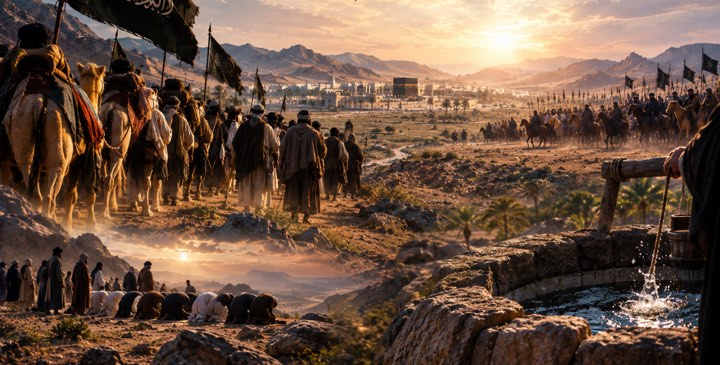
الخروج الى صلح الحديبية
بعد غزوة الأحزاب ، أرسل النبي عدد كبير من السرايا في السنة السادسة من الهجرة فكانت ثمرة هذه السرايا أن أصبح للمسلمين القوة الإقليمية الأولى في الجزيرة وأتجه ميزان القوى بوضوح لصالح المسلمين على حساب قريش في ذلك الوقت ، وفي شهر شوال من السنة السادسة من الهجرة، رأى النبي رؤيا في منامه أنه و أصحابه يدخلون المسجد الحرام وقد حلقوا شعورهم،،،،ورؤيا الأنبياء وحي من الله تعالى وعلى الفور أعلن النبي أنه سيخرج لأداء {{ العمرة }} ودعا كل المسلمين في المدينة للخروج معه، وكذلك الأعراب حول المدينة كانت الفكرة مفاجئة للجميع فالحرب بين المسلمين وقريش قائمة وفي أوجها،،،، ولم تكن قد مرت على غزوة {{ الأحزاب }} ومحاولة قريش غزو المدينة سوى عام واحد و كان مجرد الاقتراب من مكة فيها خطورة شديدة ومع ذلك كانت قوانين الجزيرة العربية، وأعراف قريش نفسها تقضي بألا تتعرض قريش لمن يدخل {{ مكة المكرمة }} مهما كانت بينه وبين قريش من خلافات بل على العكس عليها أن تقوم بحمايته ،،،اطعامه وسقايته ،،،خدمته وقد كان معروفا أن الرجل الذي يرى قاتل أبيه في مكة ، فلا يستطيع أن يتعرض عليه حتى يخرج من حرمها (منطقة الكعبة) فمكة كانت لكل العرب في الجاهلية قال تعالى {{ إِنَّ الَّذِينَ كَفَرُوا وَيَصُدُّونَ عَن سَبِيلِ اللَّهِ وَالْمَسْجِدِ الْحَرَامِ الَّذِي جَعَلْنَاهُ لِلنَّاسِ سَوَاء الْعَاكِفُ فِيهِ وَالْبَادِ وَمَن يُرِدْ فِيهِ بِإِلْحَادٍ بِظُلْمٍ نُذِقْهُ مِنْ عَذَابٍ أَلِيم}} ومع ذلك، لم يكن الأمر بهذه السهولة على الصحابة لأنه ليس هناك ما يضمن أن قريش ستحترم هذه الأعراف وقد انتهكت قريش اعرافها قبل ذلك كثيرا سابقًا، لم تحدث سوى حالتين عمرة فقط منذ هجرة النبي 1. الأولى بعد الهجرة مباشرة، وقد قام بها سعد بن معاذ وعندما عرف أبو جهل تصدى له ومنعه من استكمال طوافه بالكعبة 2. ومرة ثانية بعد الهجرة بثلاثة سنوات، قام بها {{ثمامة بن اثال}} سيد بني حنيفة وقد رفع صوته وجهر بالتكبير ، وقد تعرضت له قريش كذلك، ولكنها لم تستطع منعه لمكانته كان خروج المسلمين لأداء العمرة في ذلك الوقت خطورة شديدة جدا ولذلك لم يستجب للنبي سوى المؤمنين الحقيقين فقط،،، بينما رفض المنافقون الخروج الى هذه الرحلة المهلكة من وجهة نظرهم،،، وكذلك لم يخرج الأعراب الذين حول المدينة فكان عدد الذين خرجوا مع النبي ١٤٠٠ من الصحابة ولكنه كان صف نقي خالص ليس فيه منافقون،،، وليس فيه أشخاص ايمانهم ضعيف خرج النبي واصحابه في ذي القعدة في نهاية السنة السادسة من الهجرة وكان مع المسلمين ، عدد كبير من الإبل لذبحها في مكة وهو ما يسمى {{ الهَدِي}} (والهدي هو ما يُهْدى من الماشية الى الحرم تقرباً الى الله تعالى وافضله هو الإبل (الجمل) وكانت تعليمات النبي لأصحابه واضحة،،، و هو الخروج بسلاح المسافر فقط لأنه خرج لأداء العمرة ولم يخرج للحرب،،، ولم يحملوا معهم ملابس الحرب حتى ولو على سبيل الاحتياط و ذلك حتى يُؤكد النبي أنه لم يخرج لحرب ، وانما خرج لأداء العمرة ، وكان فيه دليل على شجاعة المسلمين وثقتهم بأنفسهم وصل النبي والمسلمون الى منطقة {{ ذي الحليفة }} وهي التي نطلق عليها الأن اسم {{ آبيار علي }} وهو المكان الذي {{ يُحْرِم }} (أي يستعد منه القادمون من المدينة الى مكة للعمرة أو الحج بالإحرام وهو لبس ملابس الإحرام) وأحرم المسلمون من هذا المكان، وبدؤا في التلبية {{ لبيك اللهم لبيك .. لبيك لا شريك لك لبيك .. إن الحمد والنعمة لك والملك .. لا شريك لك }} وصلت الأخبار الى قريش بخروج النبي والمسلمون لأداء العمرة وأجمعت قريش رأيها على منعهم دخول مكة والتصدي لهم وكان النبي في طريقه يسير على بركة الله فعندما وصل المسلمون الى منطقة {{ كراع الغميم }} وهي ( منطقة تبعد عن مكة ٦٣ كم فقط) وجدوا أن قريش قد جمعت جيشا لصد المسلمين عن التقدم في اتجاه مكة، وكان هذا الجيش مكون من قريش نفسها ومن {{ الأحابيش }}، وهي مجموعة من القبائل المتحالفة مع قريش، وقد اطلق عليها الأحابيش لتجمعها وكان هذا أول مظهر من مظاهر نية قريش لمنع المسلمين من أداء العمرة، وعدم احترامها للأعراف التي تقضي بعدم التعرض لمن يأتي الى مكة معتمرا واستشار النبي صلى صحابته ، لأن الأمر خطير وكان رأي البعض هو قتال هؤلاء الأحباش وكان ممن تكلم أبو بكر الصديق فقال:_ يا رسول الله ،،، الله ورسوله أعلم ،،، إنما جئنا معتمرين ولم نجيء لقتال أحد،،، ولكن من حال بيننا وبين البيت قاتلناه فقبل النبي و الصحابة هذا الرأي واستحسنوه فقال النبي لأصحابه:_ هل من رجل يأخذ بنا عن غير طريقهم فندخل مكة من غير الطريق المألوف ؟؟ فقال رجل له خبرة بالطرقات :_ انا يا رسول الله فسلك بهم طريق وعر ومنحني لا يتسع هذا الطريق إلا لرجلين وثلاثة وهكذا ساروا طوال الليل فسار النبي بالمسلمين في طريق منحرف متجنبا جيش مكة، وأكمل المسلمون طريقهم، ولم يعترض جيش قريش والأحباش المسلمون فلما وصل النبي الى منطقة تسمى {{ عسفان }} و تبعد عن مكة حوالي ٤٠ كم ،،،، علمت قريش بذلك فأرسلت قريش لهم فرقة قوية من الفرسان عددها ٢٠٠ فارس وكان على راسهم {{ خالد بن الوليد }} ووقف ورائهم جيش مكة من قريش والأحابيش وفي ذلك الوقت جاء موعد {{ صلاة الظهر }} ووقف المسلمون يصلون الظهر والمسلمون لم يأخروا الصلاة عن وقتها الا في {{غزوة الأحزاب }} فقط وقف النبي مطمئنا لصلاة الظهر ،،، ووقف خلفه المسلمون ،،،، وكان {{ خالد بن الوليد }} قائد فرسان المشركين يراقبهم من بعيد،،، وشاهد المسلمون وهم يركعون ويسجدون، والأمر يتكرر منهم ووجد أن هناك فرصة لمهاجمة المسلمين وهم في صلاتهم فسأل خالد من حوله :_ هل سيصلي المسلمون مثل هذه الصلاة مرة أخرى ؟ فقال لهم بعضهم:_ نعم إن لهم صلاةً بعد هذه [[ أي العصر ]] هي أحب إليهم من أموالهم وأبنائهم فتجهز {{ خالد بن الوليد }} وجهز كتيبته للإنقضاض على المسلمين في صلاة العصر واستعد جيش مكة لذلك ، الغدر من المسلمين وهذا يدل على خوف جيش مكة الشديد من المسلمين حتى وهم بسلاح المسافر ، وقريش بكامل عتادها، وحتى وهم يملكون ٢٠٠ فارس، ولم يكن مع المسلمين فارس واحد فنزل جبريل على النبي بتشريع {{ صلاة الخوف }} فلما حضرت صلاة العصر، ووقف النبي يصلي بالمسلمين {{ صلاة الخوف }} لأول مرة فصلى،،، وصلى خلفه نصف الصحابة والنصف الثاني من الصحابة وقف خلف المسلمون لحراستهم،،،، وأتم النبي صلاة ركعتين ثم وهو في التشهد، أنهى الصحابة الصلاة وبقي النبي ولم يسلم و بدّل الصحابة مواقعهم (من كان يصلّي أصبح يحرس،،، ومن كان يحرس أصبح يصلّي) فلما رأى {{ خالد بن الوليد}} ذلك وهو يراقبهم من بعيد ذهل وقال متعجباً :_ إن القوم ممنوعون (محمِيّون)!!! بعد أن صلى المسلمون العصر، عاد {{خالد بن الوليد }} بكتيبته الى مكة ليخبر قريش، أن محمدا ومن معه لم يأتوا لقتال ،،، وكانت مكة في قمة ارتباكها ، وغير قادرة على اتخاذ أي قرار ثم انحرف الرسول بالمسلمين مرة أخرى متجنباً جيش مكة ، وأكمل المسلمون طريقهم حتى اقترب المسلمون جدا من مكة و وصلوا الى وادي أسمه {{ الحديبيبة }} أرضه منبسطه وسبب تسميته {{ الحديبية }} لان فيه {{ بئر الحديبية }} و سمي هكذا لان ماءه قليل فيحدب ظهر الرجل عندما يشرب منه كان بين المسلمين و بين مكة اثنين أو ثلاثة كيلومتر ،،،، وأصبحوا يرونها أمام عيونهم من بعيد وأصبح الموقف شديد الحرج ، ففي أي لحظة يمكن أن يقع القتال أراد النبي أن يكمل طريقه ويدخل مكة لكن بركت (جلست) ناقته {{ القصواء }}، ورفضت أن تتحرك فزجرها النبي فلم تقم وحاول الصحابة أن يدفعونها ولكنها رفضت التحرك فقال النبي للصحابة : حبسها حابس الفيل ،،(أي منعها الله من التحرك) ،،،والذي نفسي بيده لا يسألوني [[ أي قريش ]] خطة يعظمون فيها حرمات الله إلا أعطيتهم إياها و ناقة الرسول {{ القصواء }} وهي ناقته التي دخل عليها المدينة المنورة يوم الهجرة عندما قال لاصحابه {{دعوها فإنها مأمورة }} فكانت تسير بأمر الله،،، تقودها الملائكة ،،،فلما رفضت التحرك، علم النبي انها مأمورة،، ، وحبسها الله ومنعها دخول مكة كما منع فيل أبراهة الأشرم فعسكر النبي واصحابه في ذلك الوادي {{ الحديبية }} فاشتكى المسلمون لأنّ بئر {{ الحديبية }} لا يسقي ولا ماء كافٍ به فقال لهم النبي :_ انظروا هل بها من ماء ؟؟ فجاؤا النبي وقالوا :_ ليس فيها إلا الدلوين او الثلاث ؟!! فأخذ سهماً وأعطاه لأحد اصحابه ،،فقال : انزل فيها [[ اي البئر ]] واغرسه فيها باسم الله فنزل الرجل وقال :_ بسم الله،،، وغرس السهم في وسط البئر يقول اصحابه (وهم فوق ١٥٠٠ رجل):_ والذي بعثه بالحق ،،،، لقد أخذ الماء يفور ، وله هدير كأنه الماء يغلي بالقدور ،،،، فما أن أسرعنا حتى أخرجنا صحابنا وإلا كان قد غرق ،،،، ففار الماء وفاض حتى ملء البئر
The Journey to the Treaty of Hudaybiyyah After the Battle of the Confederates, the Prophet ﷺ sent a large number of military expeditions during the sixth year after the Hijrah. The result of these expeditions was that the Muslims became the leading regional power in the Arabian Peninsula, and the balance of power clearly shifted in favor of the Muslims, at the expense of Quraysh. At that time, in the month of Shawwal of the sixth year after the Hijrah, the Prophet ﷺ saw a vision in his sleep that he and his Companions were entering the Sacred Mosque, having shaved their heads. The visions of the prophets are revelation from Allah تعالى. Immediately, the Prophet ﷺ announced that he would set out to perform ʿUmrah, and he invited all the Muslims in Madinah to go with him, as well as the Bedouins living around Madinah. The idea was surprising to everyone. The war between the Muslims and Quraysh was still ongoing and had reached its peak. Only one year had passed since the Battle of the Confederates and Quraysh’s attempt to invade Madinah. Simply approaching Makkah was extremely dangerous. Nevertheless, the laws and customs of the Arabian Peninsula—and even Quraysh’s own customs—dictated that Quraysh should not harm anyone who entered Makkah, regardless of whatever disputes existed between that person and Quraysh. On the contrary, they were expected to protect such a person, provide him with food and water, and serve him. It was even known that if a man saw the killer of his own father inside Makkah, he could not attack him until that person left the Sacred Precinct surrounding the Kaaba. Makkah belonged to all the Arabs during the pre-Islamic period. Allah تعالى says: “Indeed, those who disbelieve and hinder others from the way of Allah and from the Sacred Mosque—which We have made for all people, whether those who reside there or those who come from afar—and whoever intends therein wrongdoing, We will make him taste a painful punishment.” Nevertheless, the matter was not so simple for the Companions, because there was no guarantee that Quraysh would respect these customs. Quraysh had already violated its own customs many times before. Previously, there had been only two occasions on which Muslims had performed ʿUmrah after the Prophet’s migration: 1. The first was shortly after the Hijrah, when Saʿd ibn Muʿadh performed ʿUmrah. When Abu Jahl learned of it, he confronted him and prevented him from completing his circumambulation of the Kaaba. 2. The second was three years after the Hijrah, when Thumamah ibn Uthal, the leader of Banu Hanifah, performed ʿUmrah. He raised his voice and recited the takbir aloud. Quraysh also confronted him, but they could not prevent him because of his position and status. Therefore, setting out for ʿUmrah at that particular time was extremely dangerous. Only the truly sincere believers responded to the Prophet ﷺ, while the hypocrites refused to join what they considered a deadly journey. The Bedouins living around Madinah also did not join. Around 1,400 Companions set out with the Prophet ﷺ. It was a pure and sincere group: there were no hypocrites among them and no people whose faith was weak. The Prophet ﷺ and his Companions set out during Dhu al-Qiʿdah, near the end of the sixth year after the Hijrah. They took with them a large number of camels to sacrifice in Makkah. These sacrificial animals were called al-hady—livestock dedicated to the Sacred Precinct as an act of worship to Allah تعالى. The best of these animals were camels. The Prophet’s instructions to his Companions were clear: they were to carry only the weapons normally carried by travelers, because they were going to perform ʿUmrah, not to fight. They did not even take their weapons of war as a precaution. This was intended to make it absolutely clear that they had not set out to fight, but only to perform ʿUmrah. It was also a sign of the Muslims’ courage and confidence. The Prophet ﷺ and the Muslims reached Dhu al-Hulayfah, which is now known as Abyar Ali. This is the place where those coming from Madinah to Makkah for ʿUmrah or Hajj enter the state of ihram—that is, they enter the sacred state and put on the garments of ihram. The Muslims entered ihram from this place and began reciting the talbiyah: “Here I am, O Allah, here I am. Here I am, You have no partner, here I am. Indeed, all praise and blessings belong to You, and all sovereignty is Yours. You have no partner.” News reached Quraysh that the Prophet ﷺ and the Muslims were setting out to perform ʿUmrah. Quraysh unanimously decided to prevent them from entering Makkah and to confront them. The Prophet ﷺ continued on his way, relying upon Allah. When the Muslims reached an area called Kuraʿ al-Ghamim, only about 63 kilometers from Makkah, they discovered that Quraysh had assembled an army to stop the Muslims from advancing toward Makkah. This army consisted of Quraysh itself and al-Ahabish, a group of tribes allied with Quraysh. They were called al-Ahabish because of their alliance and gathering together. This was the first clear sign that Quraysh intended to prevent the Muslims from performing ʿUmrah and was prepared to violate the custom that protected anyone coming to Makkah as a pilgrim. The Prophet ﷺ consulted his Companions because the situation was serious. Some of them suggested fighting these allied tribes, and among those who spoke was Abu Bakr al-Siddiq. He said: “O Messenger of Allah, Allah and His Messenger know best. We have come only to perform ʿUmrah; we have not come to fight anyone. But if someone prevents us from reaching the Sacred House, we will fight him.” The Prophet ﷺ and the Companions accepted and approved of this opinion. Then the Prophet ﷺ asked his Companions: “Is there anyone who can take us by a route other than theirs, so that we can enter Makkah by a different route?” A man who was familiar with the roads said: “I can, O Messenger of Allah.” He led them along a difficult, rugged and winding route. The path was so narrow that only two or three people could pass through at a time. They traveled throughout the night. The Prophet ﷺ led the Muslims along this alternative route, avoiding the army of Makkah. The Muslims continued on their way, and the army of Quraysh and its allies did not intercept them. When the Prophet ﷺ reached an area called ʿUsfan, about 40 kilometers from Makkah, Quraysh learned of this. Quraysh sent a strong cavalry unit of 200 horsemen, led by Khalid ibn al-Walid. Behind them stood the main army of Makkah, consisting of Quraysh and their allied tribes. At that time, the time for Dhuhr prayer arrived. The Muslims stood to pray Dhuhr. The Muslims had only delayed a prayer beyond its time on one previous occasion: during the Battle of the Confederates. The Prophet ﷺ calmly stood to lead the Dhuhr prayer, and the Muslims stood behind him. Khalid ibn al-Walid, the commander of the enemy cavalry, watched them from a distance. He saw the Muslims bowing and prostrating, and the same movements being repeated. He realized that there might be an opportunity to attack the Muslims while they were praying. Khalid asked those around him: “Will the Muslims pray another prayer like this one?” Some of them replied: “Yes. They have another prayer after this one—the ʿAsr prayer—which is more beloved to them than their wealth and their children.” Khalid ibn al-Walid prepared his cavalry unit to attack the Muslims during the ʿAsr prayer. The army of Makkah also prepared for the attack. This was an attempted surprise attack, and it demonstrated how seriously the army of Makkah feared the Muslims—even though the Muslims were carrying only the weapons of travelers, while Quraysh had its full military equipment and 200 horsemen, whereas the Muslims had not a single cavalryman. Then Jibril descended upon the Prophet ﷺ with the legislation of Salat al-Khawf—the Prayer of Fear. When the time for ʿAsr came, the Prophet ﷺ stood to lead the Muslims in the Prayer of Fear for the first time. He prayed, with half of the Companions praying behind him. The other half stood behind the praying Muslims to guard them. The Prophet ﷺ completed two rakʿahs. Then, while he remained in the tashahhud, the first group completed their prayer, while the Prophet ﷺ did not yet end his prayer with the salam. The two groups then switched positions: those who had been praying became the guards, while those who had been guarding came forward to pray. When Khalid ibn al-Walid saw this from a distance, he was astonished. He said in amazement: “These people are protected!” After the Muslims completed the ʿAsr prayer, Khalid ibn al-Walid returned with his cavalry to Makkah to inform Quraysh that Muhammad and his companions had not come to fight. Makkah was now in a state of extreme confusion and was unable to decide what to do. The Prophet ﷺ once again changed direction with the Muslims, avoiding the army of Makkah, and continued on his way. The Muslims eventually came very close to Makkah. They reached a valley called al-Hudaybiyyah, whose land was relatively flat. It was called al-Hudaybiyyah because it contained the Well of Hudaybiyyah. It was given this name because its water was scarce, so a person drinking from it would supposedly bend his back trying to draw enough water from it. The Muslims were only two or three kilometers from Makkah. They could now see it in the distance. The situation had become extremely tense. At any moment, fighting could break out. The Prophet ﷺ wanted to continue forward and enter Makkah. But his camel, al-Qaswa, sat down and refused to move. The Prophet ﷺ urged her to get up, but she would not. The Companions tried to make her move, but she refused. The Prophet ﷺ then said to his Companions: “She has been restrained by the One who restrained the elephant.” Meaning that Allah had prevented her from moving. Then he said: “By the One in Whose Hand is my soul, they will not ask me for any plan that honors the sacred limits of Allah except that I will grant it to them.” The Prophet’s camel, al-Qaswa, was the same camel that had carried him into Madinah during the Hijrah, when he told his Companions: “Leave her, for she has been commanded.” She had proceeded by Allah’s command. So when she refused to move, the Prophet ﷺ understood that she too had been commanded to stop. Allah had restrained her and prevented her from entering Makkah, just as He had prevented the elephant of Abraha from entering it. The Prophet ﷺ and his Companions therefore camped in the valley of Hudaybiyyah. The Muslims complained because the Well of Hudaybiyyah contained very little water and could not provide enough for them. The Prophet ﷺ asked them: “See whether there is any water in it.” They came back and said: “There are only two or three buckets of water in it!” The Prophet ﷺ took an arrow and gave it to one of his Companions. He said: “Go down into the well and plant it there, in the name of Allah.” The man went down and said: “In the name of Allah.” He then planted the arrow in the middle of the well. His Companions—who numbered more than 1,500 men—later said: “By the One who sent him with the truth, the water suddenly began to gush forth. It roared as though water were boiling in cooking pots. We hurried to pull our companion out, otherwise he would have drowned. The water continued to gush and overflow until it filled the entire well.”