
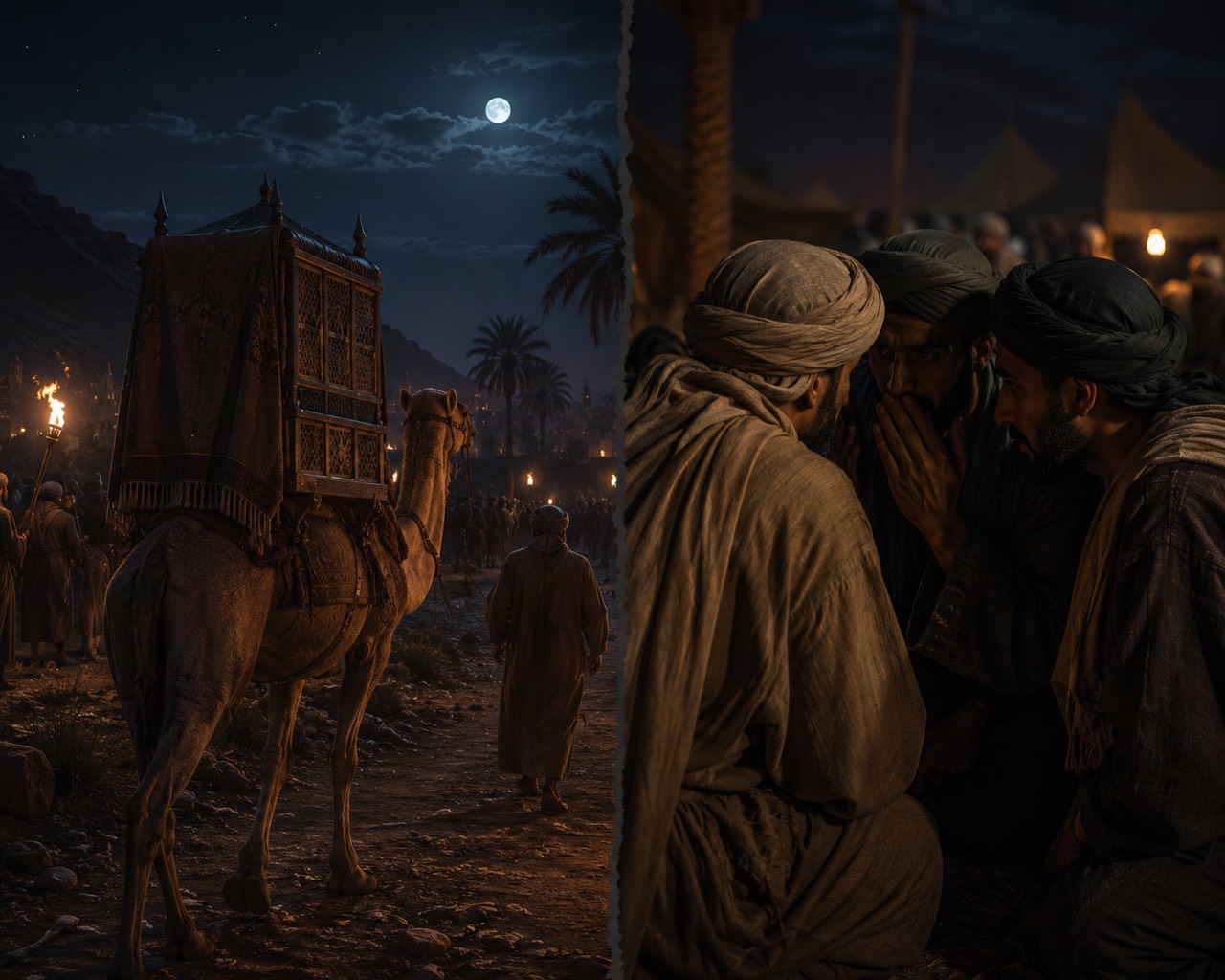
حادثة الإِفْك (الكذب والإفتراء)
عندما رجع المسلمون من غزوة {{ بني المصطلق }} ودخل المنافقون المدينة بعد فضيحتهم ونزول القرآن في شأنهم،،،كانت قلوبهم ممتلئة بالغيظ والحقد على الإسلام والمسليمن و بمجرد دخولهم المدينة ، افتعلوا مشكلة جديدة تجاه المسلمين وتجاه النبي عليه السلام وهذه الحادثة هي التي أطلق عليها القرآن العظيم اسم {{ الإِفْك }} واستغرق الحديث عنها في القران الكريم صفحة كاملة و الإِفْك هو الكذب والإفتراء وهو أشد أنواع الكذب نزلت ايات {{ الحجاب }} قبل أشهر بزواج النبي من ابنة عمته {{زينب بنت جحش}} وهي طليقة زيد بن حارثة و عندما فُرِض الحجاب على النساء، اصبحت زوجات النبي امهات المؤمنين محجبات لا يرهنّ احد كانت السيدة عائشة مع رسول الله في غزوة {{ بني المُصْطَلق }} وفي طريق العودة ، وبعد أن اقترب الجيش من المدينة، ،،، وقف الجيش في أحد الأماكن ليستريح وكان ذلك في الليل،،،، وذهبت السيدة {{ عائشة }} لتقضي حاجة لها،،، و لشدة خجلها، ابتعدت عن الجيش أكثر و أكثر وعندما عادت، وجدت أنها قد فقدت عقد لها كانت قد أعطتها لها أمها عند زواجها،،، وكان العقد ثمين به حجر من العقيق ، ومصنوع في بلد في اليمن،،،كان من اغلى الأنواع،،،، فعزّ عليها العقد ،،، فعادت السيدة عائشة مرة أخرى الى المكان الذي كانت فيه لتبحث عن العقد وتأخرت السيدة {{ عائشة }} بعض الوقت،،،والوقت كان في الليل ،،، استعجل رسول الله الجيش بسبب الفتنة التي افتعلها ابن سلول بين المهاجرين و الانصار … فبدأ الجيش يتحرك و حمل الجيش هودجها دون علم منها و مضوْ [[ والهودج هو غرفة صغيرة من الخشب توضع فوق الجمل وتركب فيه المرأة حتى لا يراها أحد ]] كانوا يعتقدون أن السيدة عائشة داخل الهودج لأنّها كانت في ذلك الوقت خفيفة الوزن جدا كما أنّ الهودج لا يكشف ما بداخله عندما عادت السيدة عائشة، فوجدت الجيش قد تحرك،،،فخافت أن تسير خلف الجيش،،، فتفقد طريقها وكان الوقت ليلاً،،، فجلست مكانها وقالت في نفسها :_ أن الرسول عندما يكتشف عدم وجودها ، فسيعود مرة أخرى،،، خاصة أنه كان من عادته أن يسير بجوار بعيرها ويتحدث إليها ثم غلبتها عيناها فنامت في مكانها في ذلك الوقت، كان أحد الصحابة واسمه {{ صفوان بن المعطل }} يسير خلف الجيش متأخرا عنه وكان {{ صفوان }} من خيرة الصحابة فقد شهد غزوة بدر وقد استشهد بعد ذلك في أحد الغزوات في خلافة عمر بن الخطاب وكانت هذه هي عادة العرب في ذلك الوقت ، أن يسير أحد افراد الجيش ( أصحاب الخبرة في طرق الصحراء ) خلف الجيش حتى اذا وقع أي شيء من متاع الجيش أخذه معه و كان {{صفوان }} لا يسير بالليل ،،،، وإنما يسير في الصباح حتى يظهر له ما وقع من الجيش فلمّا تقدم {{ صفوان }} مع طلوع الصبح، فرأى سواد انسان من بعيد ،،،، فأقترب،،، فوجد السيدة {{ عائشة }} نائمة،،، ، فأراد أن يوقظها،،،، فأسترجع ( أي قال إنا لله وإنا إليه راجعون) بصوت مرتفع ،،،،، فاستيقظت ،،، وغطت وجهها بجلبابها ركبت السيدة عائشة على الجمل و سار بها لاحقًا خطى صفوان الذي كان يسير أمامه،،، تقول السيدة عائشة: والله ما كلمني كلمة واحدة و عندما وصلا الى الجيش وشاهد المسلمون السيدة {{عائشة}} على الجمل يقودها صفوان حاول رأس النفاق {{ عبد الله بن أبي بن سلول}} أن يفتعل فتنة جديدة قال للمنافقين حوله: _من هذه ؟ !! قالوا له :_ عائشة زوج النبي قال :_ زوجة نبيكم ؟؟ !!!!! ومن هذا الذي معها ؟؟ صفوان ؟ !!!! هل باتت ليلة كاملة مع رجل لا تعرفه ؟؟؟؟ ثم اقبلت في وقت الظهر ؟؟ ثم تحول بحديثه عن الزنا وبشاعته ،،،وسمع حديثه أصحابه المنافقون ،،،فأخذوا يرددون هذا الكلام في المدينة بالتلميح دون التصريح ( حتى لا يؤخذ عليهم أي شيء) و قد نزلت آيات قرآنية فضحت فعلهم الشنيع اما النبي، عندما وضعوا هودج عائشة فلم يجدها ،،،وكان مهموم لذلك يقول :_ أين عائشة ؟ !! لما حضرت عائشة، اخبرت النبي ما حصل معها،، فقبل الأمر،، وليس فيه ما يضر دخلت عائشة بيتها و بسبب السفر الطويل، مرضت شهرا كاملا والناس في المدينة يتحدثون عنها وهي لا تعلم شيئاً ولكن الذي لاحظته أن الرسول كان اذا دخل عليها ،،،، فانه لا يتطلف لها و يدلّلها كما اعتادت أن يفعل كلما كانت مريضة مضى شهر كامل و هي لا تعلم ما يُقال عنها في المدينة وكان هذا الموقف من أشد الإبتلاءات التي مر بها النبي وكل ذلك في وقت هو أحرج و أصعب لحظات الدعوة الإسلامية ،،، لأنه في ذلك الوقت، كانت الأخبار تصل الى المدينة بأن القبائل تتجمع لغزو المدينة {{ بغزوة الأحزاب}} فلمّا اقتربت السيدة عائشة من الشفاء،،،، فخرجت لقضاء حاجتها مع أحد النساء من المهاجرين من قرابتها واسمها {{ أم مسطح }} وبينما هما في الطريق، تَعَثَّرَت/ داست على {{ أم مسطح }} في طرف ثوبها المتدلي على الارض، فقالت: تعس مسطح فتعجبت السيدة عائشة وقالت لها: بئس ما قلتِ يا خالة !!!! أتسبين رجلاً شهد بدراً ؟؟!! قالت لها ام مسطح : يا هُنتاه ( يعني يا مسكينة لا تعلمين شي)،، أولم تسمعي ؟؟ !!!!! قالت عائشة:_ وما قال الناس؟ فأخبرتها {{ أم مسطح }} بكل ما يقوله الناس عنها، وبكل ما خاضوا فيه طوال شهر كامل فذهلت ،،، ولم تستطع أن تقضي حاجتها من هول ما سمعت،،، فعادت الى بيتها،،،، و أنفجرت بالبكاء ليلتين،،، و لم تذق الطعام ،،، ولم تقم من فراشها ،،. و ازدادت مرضا على مرضها فدخل النبي و وجدها تبكي،،، لم يسألها عن سبب بكائي فقالت: يا رسول الله،،، أتأذن لي أن آتي ابوي ؟؟ فوافق النبي ولم يمانع ذهبت السيدة {{عائشة}} الى بيت أبيها {{أبو بكر الصديق}} وقالت لأمها: يا أماه،،، ما يتحدث الناس ؟؟ فقالت لها أمها {{ أم رومان }} قالت : يا بنية هوني عليك،،،، فتأكدت السيدة {{عائشة }} من المعلومة،،،، فأغشى عليها،،،،و لمّا أفاقت، ظلت طوال الليل تبكي وزاد عليها المرض كان النبي في كرب،،، ربما أكثر من السيدة عائشة فأخذ يستشير اقرب الناس إليه من اصحابه {{ زيد بن حارثة }} فقال زيد: يا رسول الله،، ، أهلك،،، ، أهلك، ،، ما علمنا عنهم الا خيرا ثم استشار {{علي رضي الله عنه }} فقال علي : يا رسول الله لم يضيق الله عليك ،،،، والنساء سِواها كثير ، [[ بمعنى طلقها وتزوج غيرها ]]،،، و ليس ذلك لأنها قد فعلت اي شيء،،، بل لإنهاء هذه المشكلة المعلقة منذ شهر،،،، حيث أنّ المدينة في خطر،،، و معرضة لحرب من الأحزاب (تحالف القبائل ضدها) ثم تراجع عن هذا الإقتراح،،،، وأشار على النبي بأن يستجوب الخادمة التي في البيت مع {{عائشة }} فناداها النبي و سألها: أي بريرة،،، أصدقِ الله ورسوله ،،، هل رأيتِ من شيء يريبك ؟؟ فقالت: لا والذي بعثك بالحق والله ،،،، إن عائشة أطيب من الذهب و أما عمر بن الخطاب قال : ألم تخبرنا يارسول الله أن جبريل اتاك بقطعة من حرير وفيها صورة عائشة ،،، وقال لك : هذه زوجك في الدنيا و الاخرة يأمرك الله بالزواج منها ؟؟ !!! قال له النبي :_ بلى قال :_ إذن يا رسول الله ، إن الله لا يختار لك إلّا طيّبة و نقيّة،،، وانا احكم أنها بريئة ،،،وان تنزل العقوبة بكل من أتهمها النبي واثق ببرائتها ،،،، ولم يكن رأي عمر اشد صواب من رسول الله،،،، ولكن الرسول قدوة لأمة كاملة،، كان يريد حجة و برهان،،،فقام الرسول وخطب في الناس بعد حمد الله،، قائلًا: {{ يَا مَعْشَرَ الْمُسْلِمِينَ ،،،مَنْ يَعْذِرُنِي (يقصد من ينصرني على هذا الرجل قاصِدًا زعيم المنافقين ابن سلول) ،،، من يَعْذِرُنِي مِنْ رَجُلٍ قَدْ بَلَغَنِي أَذَاهُ فِي أَهْلِ بَيْتِي، فَوَاللَّهِ مَا عَلِمْتُ عَلَى أَهْلِي إِلَّا خَيْرًا، وَلَقَدْ ذَكَرُوا رَجُلًا مَا عَلِمْتُ عَلَيْهِ إِلَّا خَيْرًا، وَمَا كَانَ يَدْخُلُ عَلَى أَهْلِي إِلَّا مَعِي}} فقام سعد بن معاذ سيد الأوس وقال: - يَا رَسُولَ اللَّهِ أَنَا أَعْذِرُكَ مِنْهُ،،،، إِنْ كَانَ مِنْ الْأَوْسِ ضَرَبْتُ عُنُقَهُ، وَإِنْ كَانَ مِنْ إِخْوَانِنَا مِنْ الْخَزْرَجِ أَمَرْتَنَا فَفَعَلْنَا أَمْرَكَ سعد بن معاذ يعلم ان الانصار فريقين اوس وخزرج ،،، فلزم الأدب مع الايمان ،،، قاصدًا أنّه لو من عشيرته،، فيضرب عنقه،،، ، اما الخزرج ، فلهم سيد وهو سعد بن عبادة لذلك قال سعد وإن كان من اخواننا الخزرج أمرتنا ففعلنا أمرك ]] فقام {{ سعد بن عبادة }} وهو رجل صالح ولكن، غلبته الحمية فقال لِسَعْدٍ: - كَذَبْتَ لَعَمْرُ اللَّهِ لَا تَقْتُلُهُ وَلَا تَقْدِرُ عَلَى قَتْلِهِ فَقَامَ أُسَيْدُ بْنُ حُضَيْرٍ [[ ابن عم سعد بن معاذ ]] فَقَالَ: - كَذَبْتَ لَعَمْرُ اللَّهِ لَنَقْتُلَنَّهُ فَإِنَّكَ مُنَافِقٌ تُجَادِلُ عَنْ الْمُنَافِقِينَ هنا قام الأوس والخزرج،،،، وسل {{سعد بن معاذ }} سيفه وكاد أن يقع قتال بين الأوس والخزرج وهو ما كان يريده ويسعى اليه اليهود والمنافقون فبدأ النبي يهديء الناس حتى هدئوا وسكتوا جميعا ونزل الرسول من على المنبر واجماً حزيناً مهموماً وباتت السيدة {{عائشة }} ليلة ثانية تبكي ، ثم دخل عليها النبي و عندها أبوها و أمها وكانت هذه هي أول مرة يجلس اليها منذ بدأ الناس حديث الإفك ثم حمد الله واثنى عليه ،،، وقال : يا عائشة ،،، فإنه قد بلغني عنك كذا وكذا فإن كنت بريئة فسيبرئك الله،،، وإن كنت فعلت ذنب،،،، فأستغفري الله وتوبي إليه،،، فإن العبد إذا اعترف بذنبه ، ثم تاب الى الله ، تاب الله عليه فتوقفت عن البكاء ثم نظرت لأبيها أبي بكر وقالت : أجِب رسول الله فقال ابو بكر : ما أدري ما اقول لرسول الله ؟ فألتفتت الى امها قالت : أجِيبي رسول الله فقالت امها : ما أدري ما اقول لرسول الله ؟ فقالت السيدة عائشة: والله لقد سمعتم هذا الحديث حتى استقر في انفسكم وصدقتم به،،،، فلئن قلت لكم إني بريئة ،،، والله يعلم أني بريئة ،،،، لا تصدقوني ،،، ولئن أعترفت لكم بأمر ،،،، والله يعلم أني منه بريئة،،،، لتصدقني ثم قالت: {{فَصَبْرٌ جَمِيلٌ وَاللَّهُ الْمُسْتَعَانُ عَلَى مَا تَصِفُونَ }} رغم عدم نزول الوحي فترة طويلة و انتظار الرسول له فلما أدارت السيدة عائشة وجهها للحائط وجهشت بالبكاء الشديد فهبط الوحي على رسول الله وأخذ النبي يجهد جهداً شديدا وغشيه ما غشيه من نزول الوحي ،،،، واخذ جبينه يتصبب عرقاً فلما ذهب عنه الوحي،،، ابتسم وجهه و أشرق ابتسم في وجه عائشة وضحك و قال: أبشري يا عائشة فقد برَّأكِ الله فقالت أمها :قومي بنية ،،، فأشكري رسول الله فقالت السيدة عائشة: والله لا أقوم إليه ،،، ولا أشكره،،، ولا أشكر إلا الله الذي أنزل براءتي ،،، فنزلت على الفور ساجدة لله وأخذ رسول الله بيد السيدة {{عائشة}} ،، فانتزعت يدها ،،، فنهرها أبوها {{ أبو بكر }} ثم تلى قوله تعالى وهذه بعض الآيات مما نزل من سورة النور {{ إِنَّ الَّذِينَ جَاؤُوا بِالإِفْكِ عُصْبَةٌ مِّنكُمْ لا تَحْسَبُوهُ شَرًّا لَّكُم بَلْ هُوَ خَيْرٌ لَّكُمْ لِكُلِّ امْرِئٍ مِّنْهُم مَّا اكْتَسَبَ مِنَ الإِثْمِ وَالَّذِي تَوَلَّى كِبْرَهُ مِنْهُمْ لَهُ عَذَابٌ عَظِيمٌ *لَوْلا إِذْ سَمِعْتُمُوهُ ظَنَّ الْمُؤْمِنُونَ وَالْمُؤْمِنَاتُ بِأَنفُسِهِمْ خَيْرًا وَقَالُوا هَذَا إِفْكٌ مُّبِينٌ }} و لذلك فقد شرّع الإسلام عقوبة لمن يتهم الناس بشرفهم وهو الجلد ثمانين جلدة وطبق هذا العقاب بالفعل في ثلاثة من الذين ثبت بالفعل تناولهم هذا الأمر بكلمات صريحة واضحة لا تأويل فيها وهم ١- مسطح بن أثاثة ٢- حسان بن ثابت ٣- حمنة بنت جحش أما {{عبد الله بن أبي بن سلول}} فلم تطبق عليه العقوبة لأنّه لم يتكلم في هذا الأمر بكلمات صريحة ولكن توعده الله تعالى هو و أصحابه من المنافقين بالعذاب الشديد يوم القيامة
The Incident of the Ifk (The Falsehood and Slander) When the Muslims returned from the expedition against Banu al-Mustaliq, and the hypocrites entered Medina after their disgrace and after the Qur’an had revealed verses concerning them, their hearts were filled with resentment and hatred toward Islam and the Muslims. As soon as they entered Medina, they created another problem against the Muslims and against the Prophet, peace and blessings be upon him. This incident was given the name “Al-Ifk” in the Noble Qur’an, and an entire page of the Qur’an was devoted to discussing it. Al-Ifk means falsehood and slander, and it is considered one of the most serious forms of lying. The verses concerning hijab had been revealed several months earlier, following the Prophet’s marriage to his cousin Zaynab bint Jahsh, who had previously been married to Zayd ibn Harithah. When hijab was prescribed for women, the wives of the Prophet—the Mothers of the Believers—became veiled and were not to be seen by others. Lady Aisha was accompanying the Messenger of Allah during the expedition of Banu al-Mustaliq. On the journey back, after the army had approached Medina, the army stopped at a place to rest during the night. Lady Aisha went away to relieve herself. Because of her great modesty, she moved farther and farther away from the army. When she returned, she discovered that she had lost a necklace that her mother had given her when she married. The necklace was valuable, containing a stone of agate and made in Yemen. It was among the most precious kinds, so she was greatly concerned about losing it. Lady Aisha returned to the place where she had been in order to search for her necklace. She was delayed for some time, and it was still nighttime. The Messenger of Allah had urged the army to move quickly because of the unrest that Ibn Ubayy had attempted to create between the Muhajirun and the Ansar. Therefore, the army began moving. The people carried Aisha’s howdah onto the camel without realizing that she was not inside and continued their journey. A howdah was a small wooden enclosure placed on top of a camel, in which a woman could ride without being seen. They assumed that Lady Aisha was inside because she was very light in weight at that time, and the howdah did not reveal what was inside it. When Lady Aisha returned, she discovered that the army had already departed. She was afraid to follow the army because she might lose her way in the darkness. Therefore, she sat where she was and thought: “When the Messenger of Allah discovers that I am missing, he will return for me.” She especially expected this because he was accustomed to riding near her camel and speaking with her. Eventually, sleep overcame her, and she fell asleep where she was. At that time, one of the Companions, named Safwan ibn al-Mu’attal, was traveling behind the army. Safwan was among the distinguished Companions. He had participated in the Battle of Badr and was later martyred in one of the expeditions during the caliphate of Umar ibn al-Khattab. It was customary among the Arabs at that time for someone experienced in desert routes to travel behind the army and collect anything that might have fallen from the travelers. Safwan did not travel during the night. Instead, he traveled in the morning, when he could see anything that the army might have left behind. When Safwan approached at dawn, he saw the outline of a person in the distance. He came closer and found Lady Aisha asleep. Wanting to wake her, he said loudly: “Inna lillahi wa inna ilayhi raji’un.” “Indeed, we belong to Allah, and indeed to Him we shall return.” Lady Aisha woke up and immediately covered her face with her garment. Lady Aisha then mounted the camel, while Safwan led it and walked ahead of her. Lady Aisha later said: “By Allah, he did not speak a single word to me.” When they eventually reached the army and the Muslims saw Lady Aisha riding on the camel led by Safwan, the leader of hypocrisy, Abdullah ibn Ubayy ibn Salul, attempted to create another fitnah. He asked the hypocrites around him: “Who is this?” They replied: “Aisha, the wife of your Prophet.” He said: “The wife of your Prophet?! And who is this man with her? Safwan?! Did she spend an entire night with a man she does not know and then arrive at midday?” He then began speaking indirectly about adultery and its seriousness. His fellow hypocrites heard him and began repeating these words throughout Medina through hints and insinuations rather than direct accusations, so that nothing explicit could be held against them. Qur’anic verses were later revealed exposing the seriousness of what they had done. Meanwhile, when the Prophet’s companions placed Aisha’s howdah on the camel and later discovered that she was not inside, the Prophet became concerned. He asked: “Where is Aisha?” When Aisha arrived, she explained what had happened to her, and he accepted her explanation, seeing nothing harmful in what had occurred. Aisha then entered her home. Because of the long journey, she became ill for an entire month. Meanwhile, the people of Medina were speaking about her, but she knew nothing about what they were saying. However, she noticed something. Whenever the Messenger of Allah entered her room, he no longer showed her the same affection and tenderness that she was accustomed to receiving whenever she was ill. An entire month passed while she remained unaware of what people were saying about her throughout Medina. This was one of the greatest trials experienced by the Prophet. It also occurred during one of the most difficult and sensitive periods of the Islamic mission, because news was reaching Medina that various tribes were gathering to attack the city in what would later become the Battle of the Confederates (Al-Ahzab). As Lady Aisha began to recover, she went out to relieve herself with one of her female relatives from among the Muhajirun, whose name was Umm Mistah. While they were walking, Umm Mistah stumbled on the edge of her garment, which was dragging on the ground, and said: “May Mistah perish!” Lady Aisha was surprised and said: “What a terrible thing you have said, Aunt! Are you insulting a man who participated in Badr?” Umm Mistah replied: “Oh, poor girl, do you not know?” Aisha asked: “What are people saying?” Umm Mistah then told her everything people had been saying about her and everything they had been discussing for an entire month. Aisha was shocked. She was so overwhelmed by what she had heard that she could not even continue to relieve herself. She returned home and began crying. For two nights, she cried continuously. She did not eat and did not leave her bed. Her illness became even worse. The Prophet entered and found her crying. He did not ask why she was crying. Instead, she said: “O Messenger of Allah, will you allow me to go to my parents?” The Prophet agreed. Lady Aisha went to the home of her father, Abu Bakr al-Siddiq, and asked her mother: “Mother, what are people saying?” Her mother, Umm Ruman, replied: “My daughter, take it easy…” At that moment, Aisha became certain that the reports were true. She fainted. When she regained consciousness, she spent the entire night crying, and her illness became even worse. The Prophet himself was deeply distressed—perhaps even more distressed than Lady Aisha. He began consulting some of the closest people among his Companions. He consulted Zayd ibn Harithah, who said: “O Messenger of Allah, they are your family. We have known nothing about them except goodness.” Then he consulted Ali, may Allah be pleased with him. Ali said: “O Messenger of Allah, Allah has not made things difficult for you, and there are many other women besides her.” Meaning that he could divorce her and marry someone else—not because Ali believed she had done anything wrong, but because he was suggesting a way to end a problem that had remained unresolved for an entire month, particularly while Medina was in danger and facing the possibility of an attack by the Confederates. Ali then withdrew this suggestion and advised the Prophet to question the servant who lived in the house with Aisha. The Prophet called her and asked: “O Barirah, speak truthfully before Allah and His Messenger. Have you ever seen anything that would cause you to doubt her?” She replied: “No, by the One who sent you with the truth. By Allah, Aisha is purer than gold.” As for Umar ibn al-Khattab, he said: “O Messenger of Allah, did you not tell us that Jibril came to you with a piece of silk containing an image of Aisha and said to you: ‘This is your wife in this world and the Hereafter, and Allah commands you to marry her’?” The Prophet replied: “Yes.” Umar said: “Then, O Messenger of Allah, Allah would not choose for you except a woman who is good and pure. I judge her to be innocent, and I believe that punishment should befall everyone who accused her.” The Prophet was confident of her innocence. Umar’s opinion was not more correct than that of the Messenger of Allah, but the Prophet was an example for an entire الأمة. He wanted evidence and proof. Therefore, the Messenger of Allah stood before the people and delivered a speech after praising Allah. He said: “O Muslims, who will excuse me concerning a man whose harm toward my family has reached me? By Allah, I have known nothing but goodness about my family. They have also mentioned a man about whom I have known nothing but goodness, and he never entered upon my family except when I was present.” Then Sa’d ibn Mu’adh, the leader of the Aws, stood and said: “O Messenger of Allah, I will deal with him for you. If he is from the Aws, I will strike his neck. And if he is from our brothers among the Khazraj, command us, and we will carry out your command.” Sa’d ibn Mu’adh knew that the Ansar were divided into two main tribes: the Aws and the Khazraj. Out of faith and good manners, he meant that if the accused person belonged to his own tribe, he would personally deal with him. But if he belonged to the Khazraj, they had their own leader, Sa’d ibn Ubadah, which is why he said: “If he is from our brothers among the Khazraj, command us and we will obey.” Then Sa’d ibn Ubadah, who was a righteous man but was overcome by tribal emotion, stood and said to Sa’d: “You are lying! By Allah, you will not kill him, and you are not capable of killing him!” Then Usayd ibn Hudayr, the cousin of Sa’d ibn Mu’adh, stood and said: “You are lying! By Allah, we will kill him. You are a hypocrite defending the hypocrites!” At that point, the Aws and the Khazraj stood up, and Sa’d ibn Mu’adh drew his sword. A fight between the Aws and the Khazraj was nearly about to break out. This was exactly what the enemies and hypocrites wanted. The Prophet began calming the people until they all became quiet. He then descended from the pulpit, deeply saddened and distressed. Lady Aisha spent another night crying. Then the Prophet entered her room while her father and mother were with her. This was the first time he had sat with her since the beginning of the rumors surrounding the incident. After praising Allah, he said: “O Aisha, such and such has reached me concerning you. If you are innocent, Allah will declare your innocence. But if you have committed a sin, then seek Allah’s forgiveness and repent to Him. For when a servant admits his sin and then repents to Allah, Allah accepts his repentance.” Aisha stopped crying. She looked at her father, Abu Bakr, and said: “Answer the Messenger of Allah.” Abu Bakr replied: “I do not know what to say to the Messenger of Allah.” She then turned to her mother and said: “Answer the Messenger of Allah.” Her mother replied: “I do not know what to say to the Messenger of Allah.” Then Lady Aisha said: “By Allah, you have heard this story so much that it has settled in your hearts, and you have come to believe it. If I tell you that I am innocent—and Allah knows that I am innocent—you will not believe me. But if I confess to something—while Allah knows that I am innocent—you will believe me.” Then she said: “So patience is most fitting, and Allah is the One whose help is sought against what you describe.” Despite the long period during which revelation had not come and the Prophet had been waiting for it, Aisha turned her face toward the wall and began crying intensely. Then revelation descended upon the Messenger of Allah. The Prophet experienced the great physical difficulty that accompanied the descent of revelation, and what usually happened to him when revelation came upon him occurred again. Sweat began pouring from his forehead. When the revelation ended, his face brightened, and he smiled. He smiled at Aisha and said: “Rejoice, O Aisha. Allah has declared you innocent.” Her mother said: “Get up, my daughter, and thank the Messenger of Allah.” But Lady Aisha said: “By Allah, I will not get up for him, and I will not thank anyone except Allah, who revealed my innocence.” She immediately prostrated to Allah in gratitude. The Messenger of Allah took Lady Aisha’s hand, but she pulled her hand away, and her father, Abu Bakr, reproached her. Then the Prophet recited the words of Allah. Among the verses revealed from Surah An-Nur were: “Indeed, those who have come with the falsehood are a group among you. Do not think it is bad for you; rather, it is good for you. For every person among them is what he has earned of sin, and he who took upon himself the greater share of it will have a great punishment. Why, when you heard it, did the believing men and believing women not think good of one another and say, ‘This is an obvious falsehood’?” Islam therefore prescribed a punishment for those who accuse people of immoral behavior: eighty lashes. This punishment was carried out against three people whose involvement in spreading the accusation was proven through clear and explicit statements without ambiguity: 1. Mistah ibn Uthathah 2. Hassan ibn Thabit 3. Hamnah bint Jahsh As for Abdullah ibn Ubayy ibn Salul, the punishment was not carried out against him because, according to this account, he did not make the accusation using explicit words. However, Allah warned him and his fellow hypocrites of severe punishment on the Day of Judgment.