
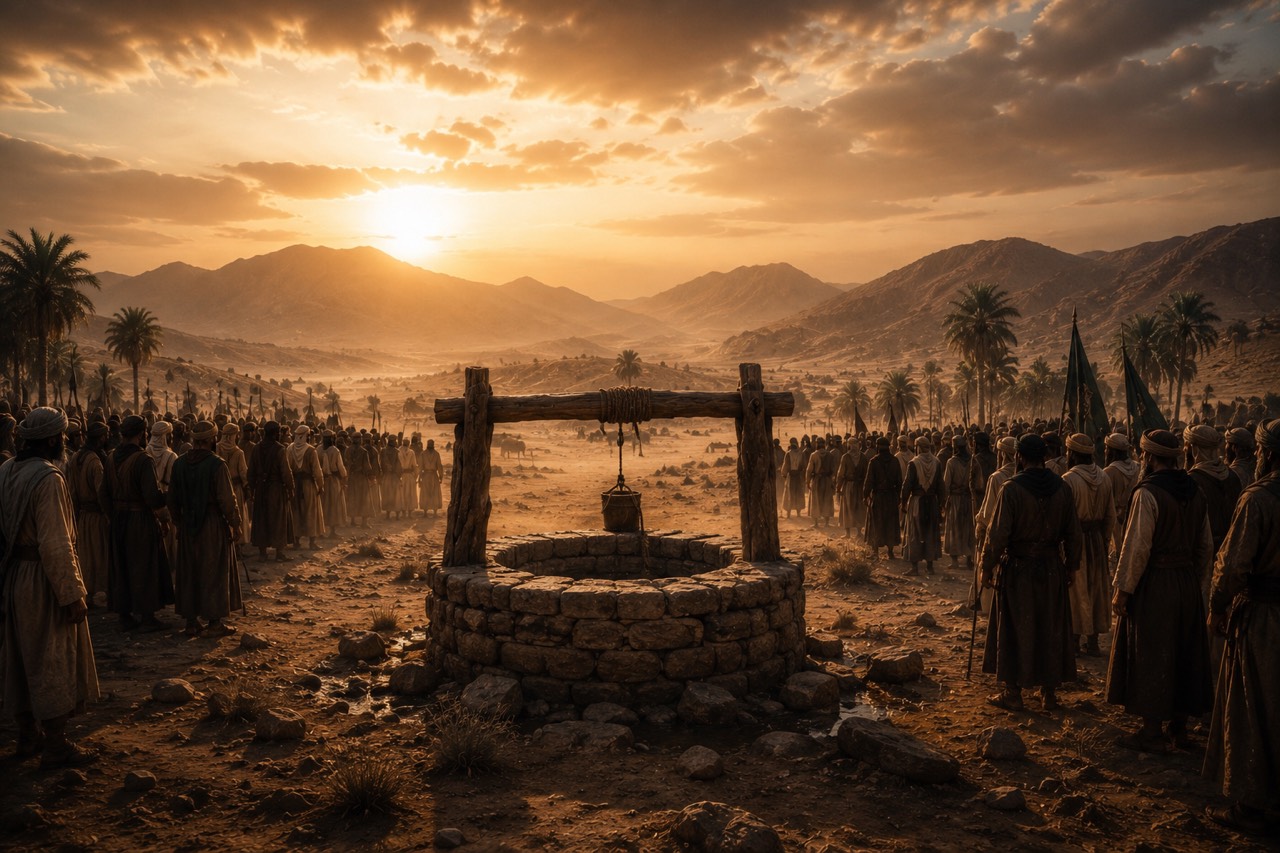
غزوة بني المصطلق والفتنة- الجزء الأول
في السنة الخامسة من الهجرة، بلغ النبي أن قبيلة {{ بني المصطلق}} تستعد لغزو المدينة بني المصطلق هي أحد فروع قبيلة {{ خزاعة}} ،،،،وكانت ديار {{خزاعة }} منتشرة على الطريق من مكة الى المدينة من بداية ٣٠ كم من مكة الى ٢٤٠ كم،،،، ولذلك فإن {{ خزاعة }} كان موقعها مهم جدا في الصراع بين المسلمين وبين قريش،،،، واتخذت {{ خزاعة}} موقفا محايدا بالنسبة للصراع بين المسلمين وبين قريش،،، فهي لم تدخل في عداء مع المسلمين لوجود صلات نسب ومصالح مع الأنصار وفي نفس الوقت لم يدخلوا في الإسلام لأن لهم مصالح مع قريش،،،، لأن خزاعة في طريق تجارة قريش الى الشام ، وهم يستفيدون بذلك وأيضا لأن أحد أصنام العرب الشهيرة وهي {{مناة}} تقع في ديارها فكان العرب يحجون الى هذا الصنم،،، ومن ثم كانوا يستفيدون من ذلك مادياً ومعنوياً من أجل ذلك، اتخذت قبائل {{ خزاعة }} موقفاً محايداً في الصراع بين المسلمين وبين قريش باستثناء {{ بني المصطلق }} وهي كما ذكرنا أحد فروع قبائل {{ خزاعة }}،،،وكانت ديارها في وسط ديار {{ خزاعة }} ،،،،والتي اتخذت موقفا معاديا للمسلمين لدرجة أنها اشتركت مع قريش في حرب المسلمين في غزوة أُحُد كان سيدهم اسمه {{ الحارث ابن ابي ضرار }} وفي بداية السنة الخامسة من الهجرة، اتخذت {{ بني المصطلق }} بقيادة {{ الحارث بن أبي ضرار }} قرارها بتجميع القبائل لغزو المدينة ووصلت هذه الأخبار الى الرسول ،،، فأرسل أحد الصحابة وهو {{ بريدة بن الحُصيب }} حتى يتأكد من نيّتهم فذهب إليهم ،،،ودخل فيهم ،،،وأظهر أنه معهم ،،،وأنه يريد عونهم في حربهم ضد المسلمين ،،،وتحدث مع سيدهم وهو {{ الحارث بن أبي ضرار }} وتأكد أنهم يريدون بالفعل غزو المدينة ،،،، فعاد الى المدينة وأخبر النبي فلما تأكد النبي أن بني المصطلق و سيدهم {{ الحارث }} قد جمعوا الجموع واعدوا جيشاً لغزو المدينة، جهز النبي جيشه،،،، فكان لا ينتظر عدوه حتى يأتي إليه الى المدينة وكان شعاره {{ ما غُزِي قوم في دارهم،،، إلا ذلوا }} وهو لا يرضى الذل للمسلمين فخرج إليهم النبي في جيش يتكون من ٧٠٠ مقاتل و ٣٠ فارس وخرج معه من نسائه السيدة {{ عائشة}} والسيدة {{ أم سلمة }} والمسافة بين المدينة و بني المصطلق كبيرة حوالي ٤٠٠ كم،،،،، فعقد لوائين للمهاجرين والانصار ،،،، فأعطى لواء المهاجرين {{ لأبي بكر }} شيخ المهاجرين ولواء الانصار {{ لسعد بن عبادة }} سيد الخزرج وكان من سنة الرسول ايضاً أن يعمي الأخبار عن عدوه ،،، فكان يسير ليلاً ويكمن في النهار وشعاره {{ استعينوا على قضاء حوائجكم بالكتمان }} سار الجيش على بركة الله وأرسل الرسول أمامه العيون يستطلع خبر القوم فوجد الصحابة رجل من {{ بني المصطلق }} كان قد خرج يستطلع للعدو الطريق ، فأمسكوا به و أخذوه اسيراً فلما احضروا الأسير الجاسوس لرسول الله، فسأله النبي عن خبر القوم ،،،، فتكتم ولم يجيب النبي لانهم قومه فعرض عليه النبي الاسلام فرفض إذا، هو عدو لا يريد أن يسلم،،،،، ولا يريد ان يخبرهم بشيء عن قومه ،،،، فإن تركوه، كان ضاراً لهم،،، فقتلوه وباغت القوم على عين ماء اسمها {{ المريسيع }} فبئر {{ المريسيع }} ماءه قليلة {{ ينزُ نزاً قليلاً }} حتى اذا تجمع ونشلوه، يحتاجوا وقتاً حتى يتجمع غيره ،،، فشبهوها بالعين التي تدمع قليلاً قليلاً وصل المسلمون الى {{ بني المصطلق }} الى عين مريسيع وعسكروا هناك فلما وصل بني المصطلق {{ لعين المريسيع }} يريدون ان يشربوا منها ويتجهزوا للمضي لغزو المدينة ،،،، تفاجئوا بوجود النبي ومن مكارم اخلاق النبي هي رغبته بهداية الناس لا حربهم والاستيلاء عليهم ، فأمر النبي عمر بن الخطاب وكان جهوري الصوت أن يهدي الناس للإسلام فنادى عمر : هذا رسول الله ،،،، على رأس جيشه يناديكم ،،،، أن تقولوا لا اله إلا الله ،،،، فتعصموا دمائكم وأموالكم فرفض القوم واصطفوا للقتال،،،، وقال سيدهم {{الحارث }} إنهم لا يدخلون في دين محمد والحرب بينهم وبين المسلمين واخذوا يتراشقوا بالسهام ساعة من وقت ثم أمر النبي أصحابه أن يحملوا عليهم حملة رجل واحد وقاموا بهجوم مباغت عليهم وحاول {{ بني المصطلق }} المقاومة ولكنهم انهزموا سريعا فقُتِل منهم ١٠ ووقع رجالهم ونسائهم في الأسر بينما لم يفقد المسلمون في هذا الهجوم سوى رجل واحد كان من الاسرى ١٠٠ بيت من بني الحارث والغنيمة كانت مذهلة واستولى المسلمون على مواشيهم وكان عددهم ٢٠٠٠ من الإبل من حمر النعم و ٥ آلاف من المواشي (أي الغنم) وحقق المسلمون انتصارا ساحقا وسريعا وكان في الجيش رئيس المنافقين {{ أبن ابي سلول }} ولأول مرة يخرج مع النبي ايضاً وفي الجيش ولده {{ عبدالله بن عبدالله بن ابي بن سلول }} وهو من خيرة الصحابة جمع المسلمون الغنائم،،، وجعل الرسول عليها حارس وهو شخص يُسمى {{ شقران }} و امسك المسلمون بالاسرى من الرجال واخذوا النساء بحكم السبايا ومن سنة الرسول في الحروب أن تقسم الغنائم الى خمس أقسام: - اربعة اخماسها توزع على الجيش فوراً - خمس لله والرسول فلما قسمت الغنائم، دخلت النساء في السبي والذي اشغل تفكير النبي ليست الغنائم بل ١٠٠ بيت من اعز بيوت العرب ،،، و يعز عليهم السبي فالواحد منهم يفدي عرضه بروحه وماله ففكر النبي كثيراً كيف ينقذ ١٠٠ بيت من السبي فجلس يتدبر ، و يفكر بالامر ، ولا يروق له مثل هذا السبي فهيأ الله له السبب وكانت ابنة سيد {{ بني المصطلق}} واسمها {{ جويرية }} رضي الله عنها ( و اسلمت واصبحت بعد ذلك ام للمؤمنين وزوجة النبي )،،،، كانت فتاة حازمة ،،، وعاقلة ،،،، وكان كثيراً ما يستشيرها أبوها في شؤون إدارة العشيرة فوقعت في السبي من نصيب أحد الصحابة وهو {{ثابت بن قيس بن شماس }} ،،،، فعرضت عليه على الفور المكاتبة ،،،فكاتبته على نفسها (يعني اتفقت معه أن تدفع له مبلغ من المال مقابل أن يعتقها ،،،، وكان هذا النظام موجود عند العرب ،،،، ويطلق عليه نظام المكاتبة و هو أن يكون حراً إذا أدى قدراً مُعيناً من المال،،،، وقد أقر الآسلام هذا النظام فقال تعالى {{ فَكَاتِبُوهُمْ إِنْ عَلِمْتُمْ فِيهِمْ خَيْرًا }} ،،، بل وجعل الإسلام هذا النظام واجبا أي يجب على السيد أن يقبل المكاتبة،،،، فكان ذلك من أساليب الاسلام في الغاء نظام العبيد) فطلبت جويرية المكاتبة،،، فقال لها ثابت و هو يعلم أنها لا تملك شيء قال:_ نعم اكاتبكِ على ٨ أواقي من ذهب مقابل أن اعتقك قالت :_ فهل تأذن لي ،،،، أن أتدبر أمري ؟ قال :_ أجل تدبري امرك فخرجت من خيمته ، واتجهت نحو خيمة النبي وكان النبي في خيمته عند ام المؤمنين عائشة فكان من سنته إذا خرج النبي في فزوة،،، عمل قُرعة بين ازواجه لمن تخرج معه فكان أم المؤمنين عائشة و ام سلمة فوقفت {{جويرية }} عند باب خيمته وهي فتاة عاقلة راشدة تحسن تدبير الامور ،،،،وكانت قد رأت قبل يوم المعركة بثلاثة أيام رؤيا ،،،،كأن القمر يسير من يثرب ،،، حتى وقع في حجرها،،،، ولم تخبر أحد بهذه الرؤيا وقفت جويرية ، ورأتها السيدة عائشة وقالت السيدة عائشة وهي تقص هذه القصة :و الله ما أن رأيتها على باب حجرتي حتى كرهتها ( من باب الغيرة عند النساء لأن جويرية كانت شابة وجميلة وحلوة اللسان ) وقفت جويرية و قالت : يا رسول الله ( لا يقولها إلا مسلم )،،،، سلام الله عليك قال : وعليك السلام ، من المرأة ؟!!! قالت :_أنا جويرية بنت الحارث سيد القوم اني قد رأيت رؤيا قبل ان تأتي إلينا ،،،، وعلمت اننا مأخوذين،،، وعلمت أن عاقبتها خير لنا ،،،، فعلمت أنك رسول الله حقاً فأنا {{ أشهد أن لا اله الا الله وأن محمد رسول الله }} واعلنت اسلامها،،، فسُر النبي بإسلامها ثم قالت :_ يا رسول الله ،،،،انا بنت {{ الحارث بن أبي ضرار }} سيد قومه،،،، وقد أصابني من البلاء ما لا يخفى عليك ،،،، وقد كاتبت ثابت بن قيس على نفسي،،،، فجئتك أستعينك على كتابتي ،،، واطلب منك العون،،، فأعني يارسول الله فنظر النبي الى عقل ذكي،،،، وقوة شخصية ،،،، وتدبر لإنقاذ قومها ، وشرفها فقال لها الرسول حباً وكرامة : فهل لك في خير من ذلك ؟ قالت:_ وما هو يا رسول الله ؟ قال: _ أقضي كتابك ،،، وأتزوجك (يعني يدفع الرسول لثابت بن قيس المبلغ كله،،،،وتكون حرة،،،، ويكون هذا المبلغ هو مهرها) قالت: _نعم يا رسول الله قد فعلت فشاع الخبر بين الناس أن الرسول قد تزوج بنت {{ الحارث بن ضرار }} فقال الصحابة :_ أصبح بني المصطلق أصهار رسول الله ومن أدب الصحابة مع رسول الله، أصبحوا ينظرون إلى أسرى بني المصطلق على أنهم أصهار رسول الله، فكيف يأسرون أصهار نبيهم!! فأرجع الصحابة الأسرى الذين في أيديهم الى أهلهم وكان هذا حدثاً فريداً لم يحدث في تاريخ الجزيرة فلقد أعتقت جويرية قومها كلهم بزواجها من رسول الله ،،، مائة أهل بيت من بني المصطلق فلما رأت بني المصطلق هذه الاخلاق والكرم ،،،، دخلوا جميعا في الإسلام وبذلك، استطاع النبي بهذه الغزوة: 1. القضاء على محاولة {{بني المصطلق }} تجميع القبائل وغزو المدينة 2. توطيد هيبة المسلمين في الجزيرة 3. دخول كل {{بني المصطلق}} في الاسلام وهي البطن الوحيد في {{ خزاعة }} الذي كان يناصب الاسلام العداء يتبع الجزء الثاني،،،،،،
The Battle of Banu al-Mustaliq and the Fitnah – Part One In the fifth year after the Hijrah, news reached the Prophet ﷺ that the tribe of Banu al-Mustaliq was preparing to invade Madinah. Banu al-Mustaliq was one of the branches of the Khuza’ah tribe. The lands of Khuza’ah stretched along the trade route between Makkah and Madinah, beginning about 30 kilometers from Makkah and extending to roughly 240 kilometers. Because of this strategic location, Khuza’ah played an important role in the conflict between the Muslims and Quraysh. Khuza’ah generally adopted a neutral position in that conflict. They avoided hostility toward the Muslims because of family ties and shared interests with the Ansar. At the same time, they did not embrace Islam because they also had economic interests with Quraysh. Their territory lay on Quraysh’s commercial route to Syria, from which they benefited greatly. In addition, one of the famous idols of Arabia, Manat, stood within their territory. Arab tribes used to make pilgrimages to this idol, bringing both financial and social benefits to Khuza’ah. For these reasons, most branches of Khuza’ah remained neutral. The exception was Banu al-Mustaliq, who—as mentioned—were one of Khuza’ah’s branches. Their territory lay in the heart of Khuza’ah’s lands, yet they adopted an openly hostile stance toward the Muslims. They had even fought alongside Quraysh against the Muslims in the Battle of Uhud. Their chief was al-Harith ibn Abi Dirar. At the beginning of the fifth year after the Hijrah, under the leadership of al-Harith ibn Abi Dirar, Banu al-Mustaliq decided to gather allied tribes and prepare an attack on Madinah. When this news reached the Prophet ﷺ, he sent one of his Companions, Buraydah ibn al-Husayb, to verify their intentions. Buraydah went among them, concealed his true purpose, and acted as though he supported their campaign against the Muslims. He spoke directly with their leader, al-Harith ibn Abi Dirar, and confirmed that they were indeed preparing to invade Madinah. He then returned and informed the Prophet ﷺ. Once the Prophet ﷺ was certain that Banu al-Mustaliq had assembled an army, he prepared the Muslim forces. He never waited for an enemy to reach Madinah before taking action. His guiding principle was: “No people are invaded in the heart of their own land except that they become humiliated.” He would not accept humiliation for the Muslims. The Prophet ﷺ marched with an army of 700 fighters, including 30 cavalrymen. Among his wives who accompanied him were A’ishah and Umm Salamah. The distance between Madinah and Banu al-Mustaliq was approximately 400 kilometers. The Prophet appointed two banners: * The banner of the Muhajirun was entrusted to Abu Bakr, the elder of the Muhajirun. * The banner of the Ansar was entrusted to Sa’d ibn ’Ubadah, the chief of the Khazraj. It was also the Prophet’s practice to keep military movements concealed from the enemy. He would often travel by night and remain hidden during the day. His principle was: “Seek the fulfillment of your objectives through discretion.” As the army advanced, the Prophet ﷺ sent scouts ahead. The Muslims encountered a man from Banu al-Mustaliq who had been sent to scout their movements. They captured him and brought him before the Prophet ﷺ. The Prophet questioned him about his people, but the man refused to answer, remaining loyal to his tribe. The Prophet invited him to embrace Islam, but he refused. Since he would neither accept Islam nor provide information, and releasing him would pose a danger to the Muslim army, he was executed. The Muslims then launched a surprise approach toward a spring known as al-Muraysi’. The water of al-Muraysi’ flowed only in a slow trickle. After drawing water from it, people had to wait for it to refill. For that reason, it was likened to an eye shedding tears little by little. The Muslim army camped at al-Muraysi’. When Banu al-Mustaliq arrived at the spring to draw water and prepare for their planned march against Madinah, they were astonished to find the Prophet ﷺ already there. One of the Prophet’s noble qualities was that he preferred guiding people rather than fighting them. He instructed ’Umar ibn al-Khattab, whose voice carried powerfully, to call them to Islam. ’Umar proclaimed: “This is the Messenger of Allah at the head of his army, calling you to say: ‘There is no god but Allah,’ so that your lives and your property will be protected.” They refused. Their chief, al-Harith, declared that they would never enter Muhammad’s religion and that war lay between them and the Muslims. The two sides exchanged arrows for a short time. Then the Prophet ﷺ ordered his Companions to charge as one united force. The Muslims launched a sudden assault. Banu al-Mustaliq attempted to resist but were quickly defeated. Ten of their men were killed, while their men and women were taken captive. The Muslims lost only one man during the battle. Among the captives were one hundred households belonging to the clan of al-Harith. The spoils were immense: * 2,000 camels, including valuable red camels. * 5,000 sheep and goats. The Muslims achieved a swift and decisive victory. Present with the army was the leader of the hypocrites, ’Abdullah ibn Ubayy ibn Salul, who accompanied the Prophet on a campaign for the first time. Also present was his son, ’Abdullah ibn ’Abdullah ibn Ubayy, who was among the finest of the Companions. The Prophet appointed a guard named Shuqran to watch over the spoils. The male captives were detained, while the women became captives according to the customary rules of warfare at that time. It was the Prophet’s established practice to divide the spoils into five shares: * Four-fifths were distributed immediately among the army. * One-fifth was reserved for Allah and His Messenger, to be spent for the purposes prescribed in Islamic law. Yet what occupied the Prophet’s thoughts was not the wealth. His concern was the one hundred noble households of Banu al-Mustaliq. Among the Arabs, honor was held above everything else, and captivity was a matter of great shame. A man would willingly sacrifice both his life and wealth to protect the honor of his family. The Prophet ﷺ reflected deeply on how these families might be spared from captivity. Allah then provided the means. Among the captives was Juwayriyyah, daughter of al-Harith ibn Abi Dirar, the chief of Banu al-Mustaliq. She later embraced Islam and became one of the Mothers of the Believers through her marriage to the Prophet ﷺ. She was an intelligent, decisive woman whose father frequently sought her counsel in tribal affairs. She had fallen into the share of the Companion Thabit ibn Qays ibn Shammas. She immediately requested a mukatabah agreement—a contract allowing a captive to purchase her freedom by paying an agreed sum. Thabit, knowing she possessed nothing, said: “I will grant you the contract in exchange for eight uqiyyahs of gold.” She asked: “Will you allow me time to seek a way to obtain it?” He replied: “Yes.” She left his tent and went toward the Prophet’s tent, where he was staying with A’ishah. Whenever the Prophet set out on a military campaign, he would draw lots among his wives to determine who would accompany him. On this journey, the lot had fallen to A’ishah and Umm Salamah. Juwayriyyah stood at the entrance of the Prophet’s tent. Three days before the battle, she had seen a dream in which the moon traveled from Yathrib (Madinah) and settled in her lap, though she had told no one about it. A’ishah later related: “By Allah, the moment I saw her standing at the door of my room, I disliked seeing her.” She explained that this feeling arose from the natural jealousy women may experience, for Juwayriyyah was young, beautiful, and eloquent. Juwayriyyah said: “O Messenger of Allah, peace be upon you.” The Prophet replied: “And peace be upon you. Who are you?” She answered: “I am Juwayriyyah, daughter of al-Harith, the chief of his people.” She continued: “Before you came to us, I saw a dream. I knew that we would be taken captive, and I knew that its outcome would be good for us. Through that, I came to know that you are truly the Messenger of Allah.” She then declared: “I bear witness that there is no god but Allah, and that Muhammad is the Messenger of Allah.” The Prophet ﷺ was pleased by her acceptance of Islam. She then said: “O Messenger of Allah, I am the daughter of al-Harith ibn Abi Dirar, the chief of his people. You know the hardship that has befallen me. I have entered into a mukatabah agreement with Thabit ibn Qays, and I have come seeking your help in fulfilling it.” The Prophet recognized her intelligence, strength of character, and concern for the dignity of her people. He said: “Would you like something even better than that?” She asked: “What is it, O Messenger of Allah?” He replied: “I will pay your mukatabah on your behalf, set you free, and marry you.” In other words, the Prophet himself would pay the agreed amount to Thabit, thereby freeing her, and that payment would serve as her dowry. She replied: “Yes, O Messenger of Allah. I accept.” News soon spread that the Prophet ﷺ had married the daughter of al-Harith ibn Abi Dirar. The Companions said: “The people of Banu al-Mustaliq have now become relatives of the Messenger of Allah.” Out of respect for the Prophet, they could not bear the thought of keeping his relatives in captivity. One after another, they freed the captives in their possession and returned them to their families. It was an unprecedented event in the history of Arabia. Through her marriage to the Prophet ﷺ, Juwayriyyah became the cause of the freedom of her entire people—one hundred households of Banu al-Mustaliq. When Banu al-Mustaliq witnessed this generosity and noble conduct, they all embraced Islam. Through this campaign, the Prophet ﷺ accomplished several major objectives: 1. He prevented Banu al-Mustaliq from carrying out their plan to unite tribes and invade Madinah. 2. He strengthened the prestige and influence of the Muslims throughout Arabia. 3. The entirety of Banu al-Mustaliq—the only branch of Khuza’ah that had remained openly hostile to Islam—embraced Islam. To be continued in Part Two…